






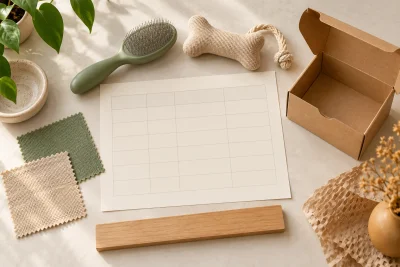
A pet product sourcing brief turns a product idea into a request that another person can answer without guessing. It connects the item you want, its intended use, the quantities you are considering and the packaging your sales channel needs. The useful outcome is a clear description of the proposed purchase, with unresolved decisions visible beside it.
Start with what you know. A retailer comparing grooming tools may have a product reference and an initial quantity, while the handle material or retail pack is still undecided. Those gaps belong in the brief. Filling them with confident language makes the request harder to interpret and can produce quotations for different configurations.
The method below focuses on nonfood pet accessories. It gives you a working structure, a fictional example and a final check before sending. Use it to prepare a focused discussion rather than to imply that availability, customization or order terms have already been agreed.
Start with the buying decision
Write a short opening paragraph explaining what your team needs to decide. Are you comparing existing models, considering a different pack for a selected item, or asking whether a proposed variation is feasible? Each question needs a different response. A request that mixes all three without priorities leaves the recipient to choose the project for you.
Add the destination market, sales channel and intended user. For example, a grooming brush intended for individual online sale needs a different presentation discussion from the same brush supplied as part of a store display. State the animal and intended routine where relevant, without turning those descriptions into unverified performance claims.
Keep the opening specific enough to guide selection. “Looking for pet accessories” gives little direction. “Comparing a compact brush for an everyday grooming range, sold individually through our online store” provides a usable starting point. It still leaves room to discuss the exact model.
Name the next decision and who will make it. “Product manager to shortlist models after reviewing dimensions and pack options” is clearer than “please send your best products.” The brief should help someone move the project one step forward.
Give each product a stable reference
Assign a line reference to each item. Your own reference can be as simple as BR-01. If you are discussing an existing catalog product, include its published name, product link and visible model reference. Preserve that identifier in later replies so that a similar-looking item does not quietly replace it.
Attach only the images needed to explain the request. Label each image by purpose: overall shape, handle detail, pack arrangement or color direction. A reference photograph can communicate appearance, but it does not establish material, dimensions, strength or suitability for a particular animal. Ask for those details separately.
When browsing pet brushes, record which visible features prompted the shortlist and which specifications still need confirmation. This keeps a catalog reference useful without treating a product photograph as a complete specification.
If two references conflict, identify the preferred one. A sketch may show the required outline while a photograph shows a surface finish. Explain that division in a sentence beside the files. Sending both without instructions invites an interpretation that your team may never have intended.
Separate requirements from preferences
Use three headings for product details: required, preferred and open. Required details define what your team can accept. Preferred details guide a recommendation but may change. Open details need a proposal or confirmation before the product can be selected.
Describe each important requirement in observable terms. Replace “premium finish” with the finish characteristics your team wants to review, such as a consistent visible surface and no rough edge at the grip. Replace “compact” with a requested dimension or a clear size constraint if you have one. Do not invent a numerical tolerance simply to make the document look technical.
For dimensions, state the unit and what is being measured. Overall length, usable brush head length and packed length are different measurements. A small annotated sketch can remove more ambiguity than a paragraph of adjectives. If a measurement came from your own reference sample, label it as your measurement pending confirmation.
When a material is undecided, request the available options and their corresponding specification. Avoid writing an assumed material into the required column. That assumption can survive into later artwork or descriptions even if the selected product uses something else.
Connect use to a review question
Use descriptions should lead to practical questions. For a grooming item, your team might want to review grip, cleaning access and the finish of the contact area. For a travel accessory, the questions may concern closure operation, packed size and how the parts are stored between uses. Choose questions that match the item.
Keep proposed checks separate from claims. “Review whether the closure remains secure during the agreed handling check” is a request to evaluate a sample. “Leakproof in all conditions” is a public claim that needs a defined basis. The first statement does not establish the second.
For items in a pet toy selection, state the intended play context and the features your team needs to examine. Avoid broad descriptions such as suitable for every breed or indestructible. A brief can record the questions that remain open without claiming universal suitability.
Write down who will resolve a question and what they need to see. A photograph may answer a layout question, while handling a sample may be necessary for a grip decision. Choosing the evidence now makes the next reply easier to assess.
Show quantity by item and variation
Give quantities at the level you intend to buy. A total for the whole range is not enough if it combines products, colors, sizes and packs. List each combination separately and show the total beneath it. Keep a requested quantity distinct from any minimum quantity that still needs confirmation.
For a fictional request, you might consider 600 brushes in green and 600 in beige, giving 1,200 individual brushes in total. Those figures illustrate the breakdown only. They are not an order recommendation, an available supply quantity or a statement about any seller's minimum.
State the selling unit beside the quantity. “1,200 units” could mean individual brushes, two-piece sets or cartons. If you want a set, list its contents and say whether every component must be packed together. The product count and the number of retail packs should reconcile.
Separate the initial purchase under discussion from possible later demand. A reorder estimate can help explain the project, but it should remain labeled as an estimate with no committed volume. Do not combine an uncertain annual forecast with the first order to suggest that a larger quantity has already been approved.
Describe packaging in layers
Begin with the unit the customer receives. Is it one loose item, one item in a box, or several items in a single set? List the contents of that retail unit. Then describe how several retail units should be grouped for handling and what information you need about the outer carton.
For each layer, distinguish a request from an existing arrangement. “Please show the current individual pack” asks for information. “Use our proposed box layout, subject to feasibility confirmation” requests a change. Neither means that a particular packaging option is available or included automatically.
Record dimensions as product dimensions or packed dimensions, with units. Ask which figures are measured and which are preliminary. If the outer carton configuration is not known, request the proposed units per carton, carton dimensions and weights for the selected pack. Leave those fields open until the arrangement is confirmed.
A packaging reference should show placement and grouping, not silently authorize material or artwork changes. Identify which parts of the reference matter. Your team may want the opening direction of a box while keeping its color undecided. Describe those choices individually so that an attractive reference does not become an accidental specification.
A set needs one further check: whether its components can be reviewed and reordered separately. If a brush and a comb form one retail pack, give the pack its own reference and retain a reference for each component. Record whether the requested quantity refers to complete sets or individual pieces. Ask for substitutions to be proposed explicitly, including any effect on the pack layout. A reply describing two loose products does not resolve a request for one assembled set. This distinction belongs beside the quantity and packaging fields, where the people preparing the response can see it.
Make branding and artwork responsibilities clear
State whether the request concerns an existing unbranded item, a proposed product mark, a retail pack design or a combination. These are separate decisions. An agreement to review packaging artwork does not confirm that a mark can be applied to the product itself.
List the files that are ready and the files still being prepared. Identify the artwork version, intended placement and the person responsible for approving it. If you only have a visual concept, call it a concept. Request the appropriate template or placement limits before treating that concept as a production file.
Use a status beside each file: reference only, for feasibility review or approved for the stated purpose. Avoid one general “approved” label covering product appearance, packaging layout and all written content. Approval should identify the specific file and the decision it covers.
If the request is for neutral packaging, explain the intended presentation and ask what the proposed pack contains. Do not assume that removing a visible logo also removes every other printed detail. Review the actual artwork or sample for the selected configuration before your team accepts it.
Record sample questions before requesting samples
A sample request becomes more useful when it names the decisions the sample should support. List the model and variation, the packaging state and the questions you want to examine. An existing product sample and a sample carrying proposed artwork may answer different questions.
Ask which features of the sample represent the proposed order and which remain provisional. A sample might demonstrate shape while its color is still a reference. Record that limitation beside the sample identifier. Otherwise, an acceptable feature can be mistaken for approval of the entire configuration.
Give your reviewer a short observation sheet based on the brief. Include the requirement, observation, unresolved issue and decision. A simple result such as “handle dimension confirmed, color still open” is more useful than an overall impression with no explanation.
Keep the sampling discussion separate from an assumption that samples are necessary for every purchase. Choose the review route for the actual item and decision. If samples are requested, confirm their scope and arrangements independently rather than assuming they are available on identical terms for every model.
Use dates that describe real milestones
State the date by which you need a response and explain what that response should enable. A shortlist review, artwork decision and goods-receipt target are different milestones. Putting one unexplained date at the top of a brief can make each reader interpret it differently.
Separate your requested dates from confirmed dates. Your preferred arrival window is a planning input until the relevant production and transport arrangements have been reviewed. If there is a fixed event behind that window, explain the constraint without implying that the schedule has been accepted.
List decisions that still affect timing, such as selecting a model, confirming a pack or preparing artwork. Assign an owner to each buyer-side action. This helps your team see whether an unresolved internal choice is preventing a useful answer.
Avoid filling a timeline with assumed durations. Ask for the expected sequence and the basis of any estimate for the proposed configuration. Keep later revisions attached to the same brief so that an old planning date does not remain in circulation after the product or pack changes.
Ask for a reply against the same fields
Structure the requested response to match your brief. For each product line, ask the recipient to confirm the proposed configuration, identify differences and list open questions. Give alternatives their own line rather than letting them replace the requested item inside a general answer.
Request product dimensions, material details, quantity conditions, pack configuration and any exclusions relevant to the proposal. Commercial terms should be confirmed for that specific item and arrangement. A brief organizes the questions but does not establish those terms by itself.
When replies arrive, check their basis before comparing them. One reply may describe a loose item and another an individually boxed item. One may use your requested color split while another assumes a single color. Return those differences for clarification instead of treating both as answers to an identical request.
Keep the original question visible beside the response. Mark a field confirmed only when the reply addresses that field clearly. Silence is an open question. A useful brief leaves that uncertainty visible until your team has enough information to decide.
A fictional brief you can adapt
The following example describes a planning exercise, not a MewPurr product specification, quotation or supply commitment. Replace every proposed value with your own requirement and keep unknowns explicit.
- Project: Everyday grooming range, first model shortlist.
- Product line: BR-01, compact handheld pet brush. Attach the chosen catalog reference and a labeled shape image.
- Market and channel: Destination country to be supplied by buyer. Individual online retail sale.
- Required: One brush per selling unit. Overall dimensions and contact-area construction to be confirmed against the selected model.
- Preferred: Green and beige directions. Grip and cleaning access to be reviewed.
- Open: Exact material, available colors, pack feasibility and model-specific quantity conditions.
- Quantity scenario: 600 individual brushes per proposed color, 1,200 total. This is a requested scenario for discussion.
- Packaging: Request the current individual pack and a proposed alternative box arrangement as separate configurations. Carton data pending selection.
- Artwork: Concept not approved. Buyer to provide files after receiving the relevant placement information.
- Sample decision: Review grip, dimensions and visible finish. Confirm which sample features represent the proposed order.
- Timing: Buyer to state shortlist review date and preferred receipt window. Both remain separate from confirmed commitments.
- Requested reply: Confirm or question each field, show deviations separately and identify the information needed for the next decision.
Keep one current version and send a focused request
Give the brief a version, date and owner. Keep a short change note whenever quantities, dimensions, colors or packaging change. Name the superseded version so that a reply cannot accidentally rely on the earlier configuration.
Before sending, check the totals, selling units and attachment names. Make sure every reference image has a stated purpose and every unknown has a question. Remove unsupported adjectives that read like established product claims. Check that the person receiving the document can tell what to confirm, what to propose and what your team still needs to decide.
You can begin without a complete technical specification. The useful minimum is a product direction, intended use, market or channel context, an honest quantity scenario and a clear next question. Develop the detail as the project becomes more specific, keeping each decision connected to its evidence.
For the next discussion, use MewPurr's sourcing page with the product reference and the fields you have already completed. A clear pet product sourcing brief gives that conversation a practical starting point and leaves the remaining decisions visible.